

Program Overview
Master of Science Program in Smart Logistics and Supply Chain Management (LSCM)
The Logistics Management is a program designed to develop knowledge and skills in quantitative data analysis, technology and management in order to produce personnel for the logistics workforce to be moral and ethical. They will also have an understanding of businesses while being capable of analyzing integrated knowledge application and working with others. The teaching of this program focuses on the use of applied information technology to manage and analyze logistics. It also utilizes case studies and work-based education to prepare students for employment after graduation. The program has received development for all executive levels, analysts and personnel in logistics including those with an interest in the logistics profession who desire to seek in-depth analysis and logistics management within an organization.
Expected Learning Outcome
| ELO1 | Apply ethical, legal, global implications in business decision making |
| ELO2 | Demonstrate understanding in business and organization management |
| ELO3 | Effectively apply quantitative analysis to logistics management |
| ELO4 | Apply research methodology to investigate and solve problems in logistics and supply chain |
| ELO5 | Critically evaluate challenges of managing logistics systems |
| ELO6 | Develop the core leadership values, or function well on multi-disciplinary, and communicate effectively |
| ELO7 | Demonstrate technology and identify software necessary to help making decisions |
Potential careers
Graduates can work in logistics operations, which are the key of businesses and exist in every organization under different names. These are in addition to roles such as executive, logistics/supply chain analyst and planner in the manufacturing market, retail business and distribution as well as businesses in logistics services provider and advisor. Additionally, graduates will be equipped to perform well in a role as such executive and analyst/planner for procurement, cargo, shipping, customer service, planning and inventory control, distribution divisions etc.
Program structure and courses
Students with a degree in logistics must enroll in not less than 37 credits by choosing one of the plans: Plan A (thesis) or Plan B (non-thesis). The duration of the program is 2 years and not exceeding 5 academic years. The program is offered as a regular program during official hours (Monday-Friday) as well as a special program outside of official hours (Saturday-Sunday).
Smart Logistics and Supply Chain Management
Program Structure
| Plan A2: Thesis | Plan B: Non-thesis | |
|---|---|---|
| Foundation courses | Non-credit | Non-credit |
| Foundation courses | 12 credits | 12 credits |
| Core courses | 12 credits | 12 credits |
| Elective courses (Minimum) | – | 9 credits |
| Seminar | 1 credits | 1 credits |
| Independent study | – | 3 credits |
| Comprehensive exam | Exam | Exam |
| Oral exam | – | Exam |
| Thesis | 12 credits | – |
| Not less than | 37 credits | 37 credits |
Course Details
- ND 4000 Foundation for Graduate Studies
- LC 4001 Reading Skills Development in English for Graduate Studies
- LC 4002 Integrated English Language Skills Development
- LC 4011 Remedial Reading Skills Development in English for Graduate Studies
- LC 4012 Remedial Integrated English Language Skills Development
- LSCM 4001 Mathematics and Statistics for Smart Logistics and Supply Chain Management
- LSCM 4002 English for Smart Logistics and Supply Chain Management
- LSCM 7101 Customer Relationship Management
- LSCM 7102 Supply Chain Risk Management
- LSCM 7103 Project Management
- LSCM 7104 Production Planning and Schedulin
- LSCM 7201 Simulationfor Logistics and Supply Chain Problems
- LSCM 7202 Spatio-Temporal Data Analysis
- LSCM 7203 Pricing and Revenue Optimization
- LSCM 7204 Business Forecasting
- LSCM 7301 Introduction to Business Analytics and Data Science
- LSCM 7302 Managing Big Data
- LSCM 7303 Applied Machine Learning
- LSCM 7401 Negotiation and Conflict Management
- LSCM 7402 Qualitative Research
- LSCM 5001 Data Analysis and Decision Models
- LSCM 5002 Logistics and Supply Chain Management
- LSCM 5003 Management Fundamental for Logistics and Supply Chain Personnel
- LSCM 5004 Information Technology Management for Digital Supply Chain
- LSCM 6001 Inventory Optimization
- LSCM 6002 Smart Logistics and Warehouse Automation
- LSCM 6003 Transportation and Distribution Network Optimization
- LSCM 6004 Supply Chain Optimization
- LSCM 8001 International Seminar in Logistics and Supply Chain Management
- LSCM 8002 Directed Studies
- LSCM 8003 Directed Studies
- LSCM 8801-8803 Selected Topics in Logistics and Supply Chain Management
- LSCM 8804-8806 Selected Topics in Logistics and Supply Chain Management
- LSCM 8807-8809 Selected Topics in Logistics and Supply Chain Management
- LSCM 9000 Independent Study
- LSCM 9004 Thesis
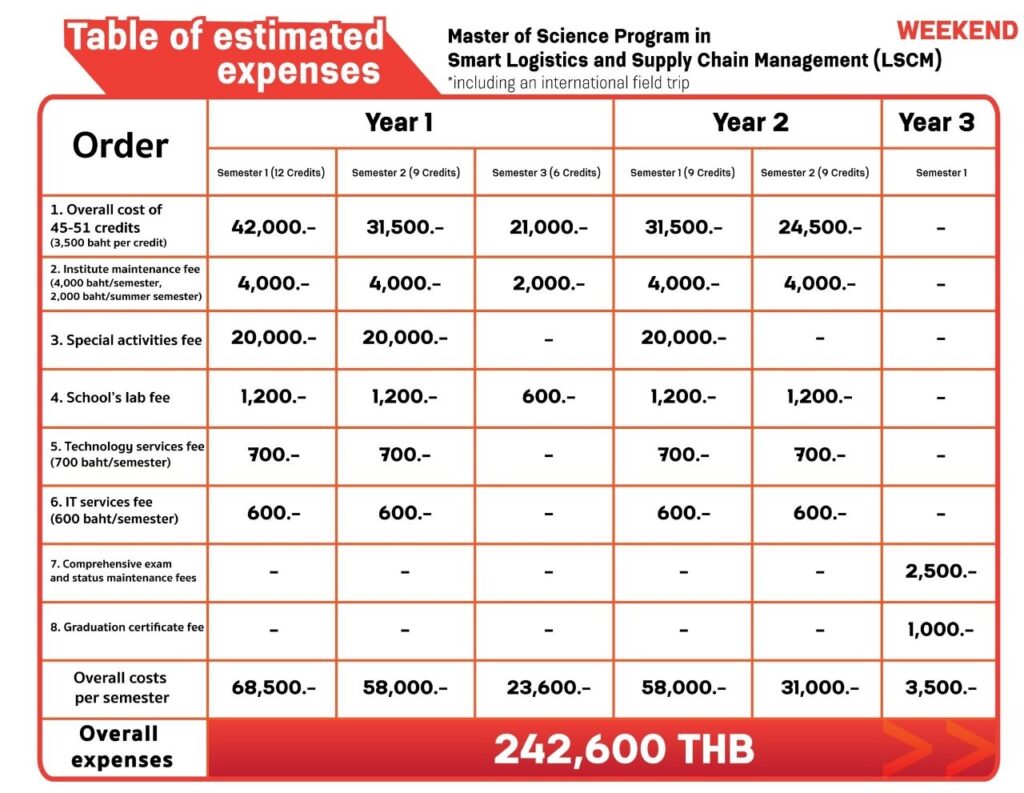
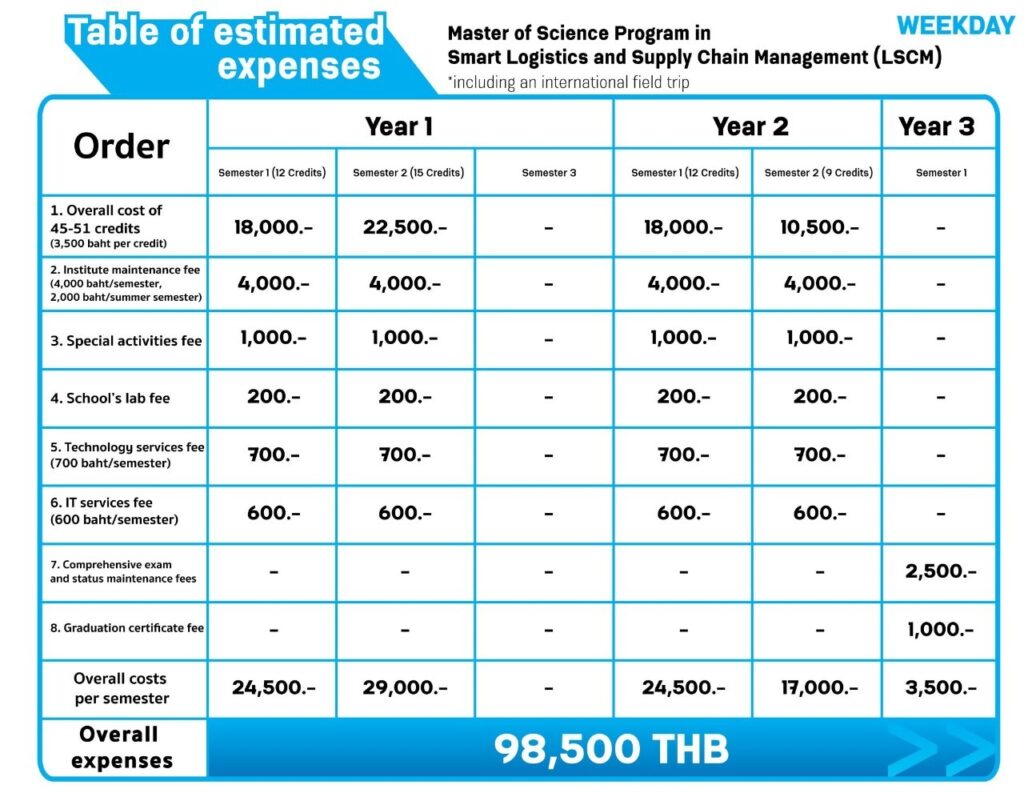
Overall Expenses
Program Detail

| Expected Learning Outcome | |
|---|---|
| ELO1 | Apply ethical, legal, global implications in business decision making |
| ELO2 | Demonstrate understanding in business and organization management |
| ELO3 | Effectively apply quantitative analysis to logistics management |
| ELO4 | Apply research methodology to investigate and solve problems in logistics and supply chain |
| ELO5 | Critically evaluate challenges of managing logistics systems |
| ELO6 | Develop the core leadership values, or function well on multi-disciplinary, and communicate effectively |
| ELO7 | Demonstrate technology and identify software necessary to help making decisions |
Contact us
GRADUATE SCHOOL OF APPLIED STATISTICS (GSAS)
National Institute of Development Administration (NIDA) Navamindradhiraj Building, 12th floor 148 Serithai Road, Klong-Chan, Bangkapi, Bangkok THAILAND 10240
Tel : 02-727-3035-40
Fax : 02-374-4061
Facebook : GSASNIDA
Line : GSAS NIDA
Youtube : Youtube